Australian Super & Pension Glossary — Key Terms Explained
Plain-language explanations of the terms used across this website.
General Retirement Terms
Assessable Assets
Assets that the government counts to determine your Age Pension eligibility.
This includes:
bank savings
shares
investment properties
superannuation
It also includes the resale value of your household contents and vehicles, but it does not include your principal home.
This includes:
bank savings
shares
investment properties
superannuation
It also includes the resale value of your household contents and vehicles, but it does not include your principal home.
Principal
If you save $100 in the bank, at the end of the year the bank will give you $5 in interest. So, your $100 is your Principal, and the $5 is your return.
Investment Return
The money you gain or lose from your investments.
Average Return
Your Super fund's return changes every year. We don't know the future, but we can use the past Average Return to get a good guess.
Real Return
Inflation makes things more expensive over time. That means $100 last year is worth $98 this year. So, your Real Return is the money you earned from investment minus inflation.
Tax Terms — SAPTO & Super Tax Basics
SAPTO
SAPTO (Seniors and Pensioners Tax Offset) is a tax offset for eligible seniors that can reduce the amount of income tax they need to pay.
Super & Pension Rules — Drawdown, Accumulation & Retirement Phase
Drawdown Rates
The government requires you to withdraw a minimum percentage of your super each year once you reach a certain age.
Retirement Phase
When you're working, your super is in the accumulation phase. After you reach 60 and meet the rules to access your super, you can move some or all of it into the retirement phase, also called an account-based pension. In this phase, you can take regular withdrawals from your super each year, within the rules.
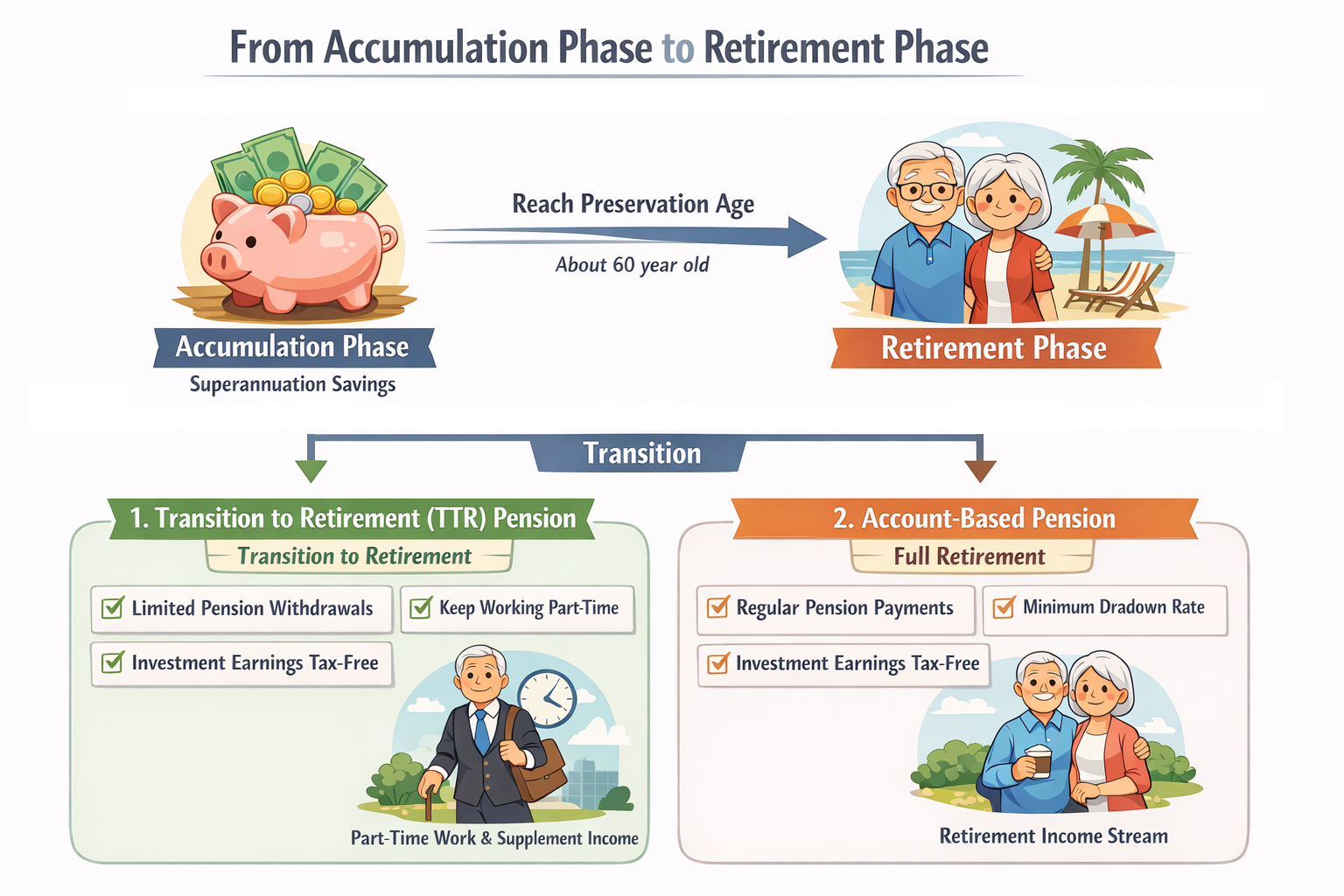
From Accumulation Phase to Retirement Phase
Have a question? We'd love to hear from you.
Feel free to reach out at — we're happy to help.